ART - KATROZ     ART - KATROZ     ART - KATROZ


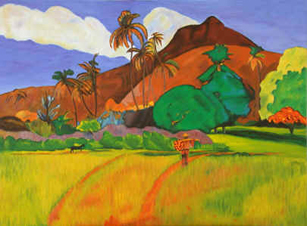
Voici notre reproduction d'après l'oeuvre de Paul Gauguin

" MONTAGNES TAHITIENNES ( 1893) ".

que vous pouvez voir à l'Institut des Arts de Minneapolis, Minnesota, USA.

This is our reproduction of Paul Gauguin's

"TAHITIAN MOUNTAINS (1893) "

which hangs at the Institute of Arts in Minneapolis, Minnesota, USA.

Cliquer pour agrandir... Click for full-screen...

Huile sur Toile - Oil on Canvas

54 x 73 cms - Ref N° CG 100

     Depuis la mi-1891, Gauguin est à Tahiti. Il a fui l'Europe, la misère, une vie familiale ratée, la vénération pesante des impressionnistes et des jeunes peintres nabis. Il  désirait se fondre dans un paradis tropical à la Jean-Jacques Rousseau : il est déçu de trouver à Tahiti une société en voie d'occidentalisation. Il se retire donc loin du chef-lieu de l'île au plus près d'une nature primale qu'il restitue dans des  couleurs flamboyantes.

            Sa touche caractéristique faite de coups de brosse parallèles est très présente dans la plus grande partie de cette toile, et particulièrement dans la partie inférieure où se marient audacieusement les tons rouges et les tons verts. Au centre du tableau, un arbre focalise le regard, qui évoque par sa forme un coq majestueux, alors que quelque part à gauche, c'est un colibri gobant un insecte qu'on distingue dans la masse de la végétation : description naturaliste, annonce du symbolisme ou simples touches d'humour ?  

                                                                                                                                                              Claude Guillemet    

     Since mid-1891, Gauguin was in Tahiti.  He had fled Europe, his hardship there, a family break-up, the heavy and growing admiration from the Impressionists and the young nabi painters.  He was seeking to find utopia in a tropical paradise in the fashion of a Jean-Jacques Rousseau ; but he  was disapppointed to find there a society in the midst of taking on the trends of the western world.  He left, therefore, the capital city of the island to find a more primitive spot, which he then brought to life on canvas using flamboyant colors.

      His characterisitic touch of parallel strokes is present in most parts of this scene, notably in the lower part where the red tones and the greens are wildly intermingled. In the center of the work, a tree captures the eye, which because of its shape makes one think of a proud rooster, whereas, a little more to the  left, we can see what could to be a hummingbird gobbling an insect. Was  this Gauguin's naturalist  rendering of the paradise he saw ? Or was it the beginning of what would be later called his "symbolism" - or simply a touch of his humour ?

                                                                                                                                      Claude Guillemet     

Cette reproduction vous intéresse ? Cliquez ci-dessous pour nous contacter.

Are you interested in this reproduction ? Click here-below to contact us.


  retour - home